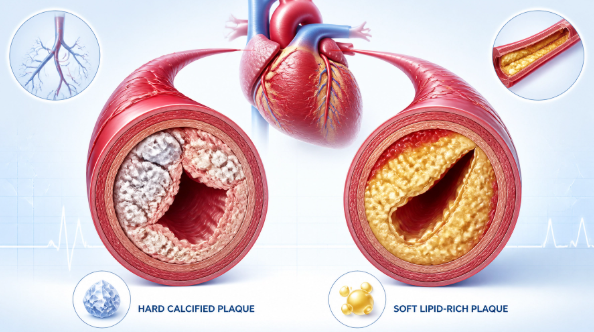

The traditional paradigm of cardiovascular risk assessment has long relied on a binary understanding of coronary artery disease: either an artery is “blocked” or it is “clear.” However, contemporary clinical research has shifted the focus from simple luminal narrowing (stenosis) to the biological composition of the arterial wall itself. This shift emphasizes the critical distinction between “hard” (calcified) plaque and “soft” (lipid-rich, non-calcified) plaque. While a coronary artery calcium (CAC) score is a valuable screening tool for identifying established atherosclerosis, emerging evidence suggests that a low or even zero calcium score may provide a false sense of security by failing to detect the most dangerous, rupture-prone “soft” plaques.
Table of Contents
- The Plaque Spectrum: Calcified vs. Non-Calcified
- The Calcium Score Blind Spot: Why “Zero” Isn’t Always Zero Risk
- Non-Obstructive Plaque: The Silent Driver of Myocardial Infarction
- Insights from Acute Coronary Syndrome: The Role of Soft Plaque Volume
- Beyond the Score: Advanced Cardiovascular Risk Management in Naples
- The Pattern is the Prescription
- Conclusion
1. The Plaque Spectrum: Calcified vs. Non-Calcified
Coronary atherosclerosis is a dynamic, inflammatory process that evolves through distinct morphological stages. “Hard” plaque is characterized by significant calcium deposits within the vessel wall; it is essentially the body’s attempt to stabilize an area of chronic inflammation. While hard plaque contributes to the total burden of disease, it is often more structurally stable and less likely to rupture acutely.
In contrast, “soft” plaque: technically referred to as non-calcified or lipid-rich plaque: is composed of a necrotic core of lipids, inflammatory cells, and debris, often covered by a thin fibrous cap. This “soft” phenotype is inherently unstable. A landmark 2025 position statement in the Journal of the American College of Cardiology (JACC): Cardiovascular Imaging by Vergallo et al. formally broadened the definition of “vulnerable” or high-risk plaque [1]. The statement emphasizes that risk is not merely a function of how much an artery is narrowed, but rather the propensity of these soft, biologically active substrates: such as thin-cap fibroatheromas (TCFA) and eruptive calcified nodules: to trigger sudden thrombosis [1].

2. The Calcium Score Blind Spot: Why “Zero” Isn’t Always Zero Risk
The coronary artery calcium (CAC) score, performed via non-contrast CT, is highly effective at detecting the presence of calcified plaque. However, because it only detects mineralized tissue, it is inherently blind to non-calcified “soft” plaque. This is a critical limitation for heart health in Naples, FL, where proactive residents seek to optimize their long-term wellness.
Recent quantitative plaque analysis published in JACC (2025) demonstrates that low-attenuation plaque (LAP) burden: a specific metric for the softest, most lipid-rich components of atherosclerosis: is a far more potent predictor of future events than calcium alone. Research indicates that individuals with a low-attenuation plaque burden exceeding 4% of their total plaque volume have a hazard ratio (HR) of approximately 4.7 for myocardial infarction (MI) [2]. This suggests that a patient with a “healthy” calcium score of zero could still harbor significant soft plaque that carries a nearly fivefold increased risk of a heart attack.
3. Non-Obstructive Plaque: The Silent Driver of Myocardial Infarction
A common clinical misconception is that only “obstructive” plaques (those blocking more than 50-70% of the artery) are dangerous. However, data from Balmforth et al. (2025) in the Heart Journal reveals that a substantial percentage of MIs arise from non-obstructive, high-risk coronary plaques [3]. These plaques are often “positively remodeled,” meaning they grow outward into the vessel wall rather than inward into the lumen; as a result, they do not restrict blood flow or cause symptoms like chest pain until the moment of rupture.
The Balmforth review underscores that coronary plaque risk must be evaluated through the lens of plaque quality rather than just luminal diameter [3]. By the time a plaque becomes obstructive and visible on a standard stress test, the opportunity for early primary prevention may have already passed.

4. Insights from Acute Coronary Syndrome: The Role of Soft Plaque Volume
Studies focusing on Acute Coronary Syndrome (ACS) patients have provided further clarity on the danger of soft plaque. Kato et al. (2025) demonstrated that in patients who have already experienced a cardiac event, the “non-culprit” plaques (those that did not cause the current heart attack) still harbor significant risk markers [4].
Specifically, Kato’s research showed that non-culprit plaques in ACS patients have significantly larger soft plaque volumes compared to stable patients. Furthermore, “protrusion-type” plaques: where the soft core physically bulges into the artery: were found to be 4.4 times more common in those with ACS [4]. This highlights that systemic inflammation often leads to multiple “vulnerable” sites throughout the coronary tree, necessitating a comprehensive, whole-body approach to concierge medicine in Naples, FL.
5. Beyond the Score: Advanced Cardiovascular Risk Management in Naples
At Goodwin Medical Center, the clinical approach to cardiovascular health transcends traditional screening. Understanding that a simple calcium score may miss the “hidden” soft plaque, the practice integrates hospital-quality emergency medicine expertise into a premier concierge medicine framework. This allows for:
- Advanced Quantitative Imaging: Moving beyond standard CT to include detailed plaque characterization and volume analysis when clinically indicated.
- In-House Lab Testing: Rapid, comprehensive blood draws to assess systemic inflammatory markers (such as hs-CRP and Lp(a)) that drive soft plaque formation.
- Personalized Longevity Optimization: Extended appointment times allow for deep-dive discussions on lipid management and therapeutic interventions that specifically target plaque stabilization.
- Continuous Access: 24/7 virtual access to your physician ensures that any subtle cardiovascular symptoms are addressed immediately, bridging the gap between preventive care and emergency medicine.

The Pattern is the Prescription
The synthesis of current 2025 research leads to a clear clinical pattern: cardiovascular risk is determined by plaque vulnerability rather than simple visibility on a calcium scan. The evidence demonstrates:
- Biological Vulnerability: Soft, lipid-rich plaque (low-attenuation plaque) is the primary substrate for acute rupture [1].
- Detection Gap: Calcium scores identify the “scars” of past inflammation but often miss the “active” soft plaque that currently threatens the patient [2].
- Risk Quantification: A low-attenuation plaque burden >4% is associated with a nearly fivefold increased risk of MI [2].
- Proactive Stabilization: Identifying non-obstructive, high-risk lesions through advanced diagnostics allows for aggressive intervention before an event occurs [3][4].
Conclusion
Relying solely on a calcium score to determine heart health is an outdated strategy in the era of precision medicine. While calcification indicates long-term atherosclerosis, it is the soft, non-calcified plaque that often dictates immediate cardiovascular risk. For those seeking the highest standard of care in Naples, FL, a comprehensive assessment: combining advanced plaque analysis, specialized lab testing, and the dedicated oversight of a concierge doctor: is the most effective path toward true cardiovascular longevity.
References
- Vergallo, R., et al. (2025). Vulnerable or High-Risk Plaque: A JACC: Cardiovascular Imaging Position Statement. JACC: Cardiovascular Imaging, 18(6), 709–740. https://doi.org/10.1016/j.jcmg.2024.12.004
- Journal of the American College of Cardiology (JACC). (2025). Quantitative Plaque Analysis and Low-Attenuation Plaque Burden: Predictive Value for Myocardial Infarction.
- Balmforth, C., et al. (2025). Identification and Management of Non-Obstructive High-Risk Coronary Plaque. Heart Journal.
- Kato, T., et al. (2025). Soft Plaque Volume and Protrusion-Type Plaque in Acute Coronary Syndrome: A Quantitative Analysis of Non-Culprit Lesions.